
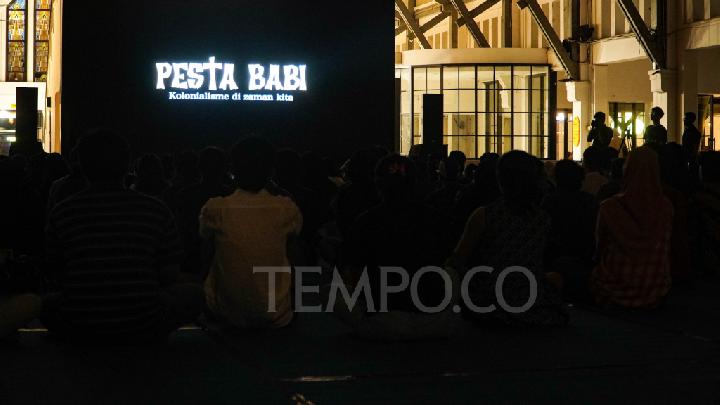
TEMPO.CO, Jakarta - Despite being banned at several campuses, the University of Indonesia's Student Executive Board (BEM UI) is planning to hold a discussion and screening of the documentary film Pesta Babi: Kolonialisme di Zaman Kita (Pig Feast: Colonialism in Our Time). The event will take place at the Prof. Dr. Soemantri Brodjonegoro Auditorium, UI Campus, Depok, on Tuesday, May 19, 2026.
According to a post on the @bemui_official Instagram account, the screening and discussion of the film Pesta Babi will feature two speakers. They are Muhamad Ramdan Andri Gunawan Wibisana, a Professor of Environmental Law at the UI Faculty of Law, and Asep Komarudin, a forest campaigner from Greenpeace Indonesia.
BEM UI explained that the screening of the film by Dandhy Laksono and Cypri Paju Dale and the subsequent discussion aim to open a dialectical space, especially in responding critically to the national strategic project (PSN) narrative. The discussion forum for the Pesta Babi film will provide a space for civil society and students to strengthen solidarity.
"(Especially) in rejecting neocolonial practices packaged with the national strategic project, and demanding justice for indigenous communities in Papua," stated BEM UI on Friday, May 15, 2026.
BEM UI argued that the implementation of the national strategic project in Papua further threatens indigenous forests through deforestation for the government's food self-sufficiency. However, these indigenous forests are crucial living spaces for indigenous communities in Southern Papua.
They believe that the national strategic project in the Land of Cenderawasih should not only be interpreted as development but as a tangible form of usurping living spaces by neglecting the constitutional rights of Papua's indigenous communities. "Policies that adopt utilitarian principles reflect the state's failure to uphold the sovereignty of indigenous communities and lean more towards corporate and oligarchic interests," said BEM UI.
The documentary film Pesta Babi depicts the impact of land expansion and industries on the loss of indigenous forests, traditional food, and the sovereignty of residents in Papua. The 90-minute film highlights the struggle of Papua's indigenous communities against the government's expansion of a national strategic project.
Authorities and campus officials dispersed discussions and screenings of the Pesta Babi film in several places. For example, at Mataram University, the campus authorities prohibited the screening of the Pesta Babi film, citing the need to maintain campus conducive conditions.
Mataram University's Vice Rector III, Sujita, admitted to having watched the Pesta Babi film. He claims that the film's content discredits the government. "It's not good to watch, it's better to watch football together," said Sujita on Thursday, May 7, 2026.
In contrast to Mataram University, UI officials stated that they would not prohibit campus residents from organizing discussions and screenings of the Pesta Babi film. Hamdi Muluk, UI's Vice Rector for Research, Innovation, Students, and Alumni, stated that discussions are part of academic freedom.
According to Hamdi, campus residents can certainly differentiate between provocative and non-provocative films. He believes that campus residents possess critical thinking. "We won't be influenced. If it's shown in an elementary school, it may be banned by the military district command. But in a university, there's no need to ban it," said Hamdi on Tuesday, May 12, 2026.
Read: No Ban on 'Pesta Babi' Film Screening, Says Rights Minister
Click here to get the latest news updates from Tempo on Google News



















:strip_icc():format(jpeg)/kly-media-production/medias/3642128/original/083822000_1637681616-2_000_Hkg660630.jpg)
:strip_icc():format(jpeg)/kly-media-production/medias/5502638/original/046269700_1770993794-vickery.jpg)











:strip_icc():format(jpeg)/kly-media-production/medias/4242587/original/071303800_1669639098-Timnas_Indonesia__-_Asnawi_Mangkualam_dan_Pratama_Arhan_copy.jpg)
