April 28, 2026 | 12:40 pm

The revision of General Election Law should strengthen public representation, not merely secure seats for political parties.
THE debate surrounding the revision of the General Election Law should ideally rest on its fundamental purpose: ensuring that every voter’s voice is fairly represented and that political competition remains a level playing field. Otherwise, election regulations easily shift from being democratic instruments into mere tools for securing narrow political interests. If this happens, the legitimacy of the election results will be under fire from the very start.
The government and the House of Representatives (DPR) are currently deliberating the General Election Law revision with a target to wrap it up by early next year. The process has been marred by a tug-of-war over party interests, among both those who are already inside the House and outside the parliament. Debate topics include, among others, the parliamentary threshold, the legislative election system, and possible separation of central and regional elections.
Behind the seemingly formal legislative process lie more fundamental questions: who determines the regulations and in whose interest these regulations are drafted. What appears to be a simple debate on the surface actually is a maneuver to secure positions. Each party proposes a design that benefits itself best. Ideas that truly focus on constituent interests are seldom heard.
Party egos are clearly visible during the parliamentary threshold discussion. The primary issue is not just the numbers, but their impact on millions of votes that can potentially be lost without representation. Therefore, the threshold formula should be designed to expand representation and not to filter it excessively.
Parties pushing to raise the threshold claim they do so in the name of parliamentary effectiveness. Yet, beneath the rhetoric, they are merely constructing hurdles for their competitors. On the other hand, parties advocating for a lower threshold clothe their arguments in the language of expanding political access, when in reality, they are simply scrambling to increase their own odds of securing a seat in the House. Ultimately, everyone is operating on a calculation of seats rather than an effort to minimize the millions of “wasted” votes that leave citizens unrepresented.
This is precisely where the meaning of democracy is at stake. Without public oversight, election rules easily become a collective tool for parties to maintain the status quo. Competition is not outright killed, it is controlled. The political arena hardens, making it increasingly difficult for alternative parties to break through. Voter choices are narrow. Democracy continues to function procedurally, but its substance continues to erode.
The stalled deliberation should not open the door to the issuance of a government regulation in lieu of law (perpu). This instrument is fundamentally an emergency measure with limited control and is susceptible to abuse. In the context of election, a perpu carries a risk of shifting the political process from deliberation to unilateral decision-making by the government.
To avoid this, the DPR must ensure that the entire design of the revision is genuinely aimed at strengthening representation and electoral fairness. Progressive rulings from the Constitutional Court, expanding voter representation, and fostering a more level playing field should serve as the primary reference. This includes rulings that correct the parliamentary threshold and remove restrictive barriers to presidential candidacies.
The 2029 General Elections should serve as a momentum to improve the representation quality. The DPR must not squander this opportunity. Otherwise, democratic backsliding will continue to occur.
Prabowo Seeks to Overhaul Indonesia's Election System, Says Senior Minister
5 September 2025
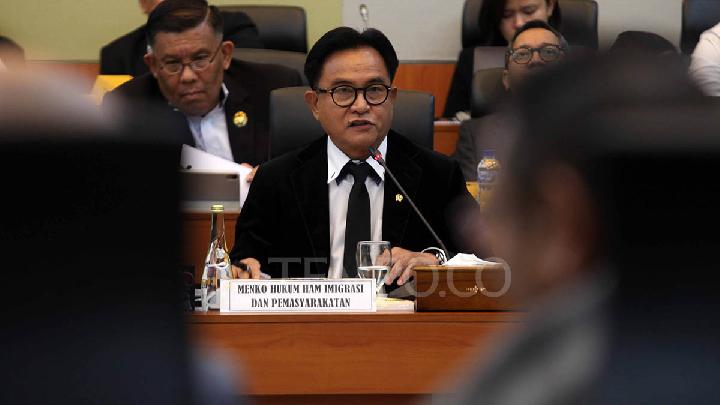
The government plans to revise the General Elections Law as President Prabowo Subianto aims to reform the political system.
House Commission II Says Election Bill Discussion to Commence 2026
9 Mei 2025

Member of the House Commission II, Muhammad Khozin, revealed that the discussion on the amendment of the Election Law will be held next year.
Supratman and Yusril on Election Law Revisions Post-Presidential Threshold Abolishment
8 Januari 2025

Minister of Law Supratman Andi Agtas ensures that the revision on Election Law will be constitutional.
Elon Musk's $1 Million Election Giveaway Tests Limits of Election Law
23 Oktober 2024

Elon Musk's $1 million giveaway for voters who sign his free-speech and gun-rights petition falls into a gray area of election law.





















:strip_icc():format(jpeg):watermark(kly-media-production/assets/images/watermarks/bola/watermark-color-landscape-new.png,1125,20,0)/kly-media-production/medias/5495647/original/074499000_1770385031-barba.jpeg)


:strip_icc():format(jpeg)/kly-media-production/medias/5414491/original/012054700_1763287155-530668458_18471777553074306_380593477510268437_n__1_.jpg)